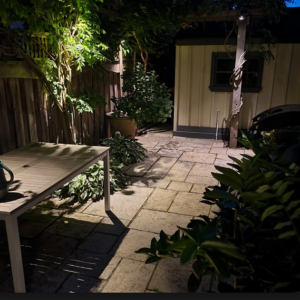
A well-lit property is about more than just aesthetics. Thoughtful landscape lighting improves safety, increases usability, highlights architectural beauty, and adds long-term value to the property.
When done correctly, outdoor lighting feels balanced, natural, and intentional. When thrown together without thoughtful planning, outdoor lighting can instead feel harsh and distracting.
Our staff at Moon Glow Lightscapes has spent years designing lighting systems that create safe, beautiful properties. We know what type of outdoor lighting is best for each space and exactly how to place it.
Why Landscape Lighting Matters More Than You May Think
Randomly placing lights or adding too many lights to a property can do more harm than good. Outdoor lighting serves three main purposes: safety, security, and aesthetics.
From a safety standpoint, proper lighting can prevent trips and falls by illuminating stairs and changes in elevation, and making walkways usable after dark. From a security perspective, lighting discourages unwanted activity by eliminating dark hiding areas. Aesthetically, lighting brings your landscape to life at night by highlighting trees, architectural details, gathering spaces, and gardens.
Where to Position Landscape Lighting
The foundation of a successful design is knowing where to position landscape lighting. Every property is different, but our team at Moon Glow Lightscapes follows a few core principles.
Entryways and Walkways
The top priority for lighting should always be front doors, driveways, and pathways. These areas need enough illumination to navigate safely without any additional glare. Best practice is often to stagger path lights instead of placing them directly across from one another, as it results in a more natural flow of light.
Steps and Elevation Changes
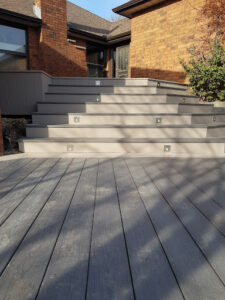
Steps, retaining walls, and changes in grade are common areas for accidents. Adding step lights, hardscape lights, and lighting that is angled downward or towards a hazard helps people navigate safely.
Architectural Features
Outdoor lighting should enhance the home or building’s architecture, but not overpower it. Columns, stonework, and textured walls are optimal candidates for accent lighting such as uplights or wall washes.
Landscape Focal Points
Trees, plants, water features, and sculptures deserve attention. Strategically placing uplighting or moonlighting can create depth and be eye-catching without overwhelming the scene.
Landscape lighting professionals design the plan in layers: foreground, midground, and background. The result is a nighttime space that looks great and is safe to move through.
How Far Should Landscape Lights Be From Each Other
Homeowners commonly ask us how far landscape lights should be from each other. The answer to this depends on a variety of factors that include the type of fixture, brightness, and the area being illuminated. There are, however, some general guidelines to follow for lighting placement to provide a sufficient amount of light and provide a great ambiance.
General Spacing Guidelines
- Pathway Lights: Pathway lights that line walkways and driveways are typically spaced 6-10 feet apart and can be staggered on each side to provide a consistent lighting effect.
- Accent Lights: Accent lights spotlight focal points like trees, plants, and hardscape features. They should be adjusted to avoid beam overlapping or hot spots. For features under 10 feet tall, accent lights should be placed 3 to 5 feet apart. For larger features, accent lights should be placed up to 15 feet apart, depending on the beam spread.
- Uplights: Uplights for trees or other features are positioned based on height and beam spread.
Lights that are placed too far apart result in dark areas, while lights that are spaced too closely together result in over-lighting and glare. To achieve the best lighting results, a professional lighting plan will consider the beam angle, lumen output, and surrounding surfaces.
Different Types of Lighting Options
There are many landscape and outdoor lighting options available, and it’s important to know the effectiveness of each when deciding what type of outdoor lighting is best for your property, as the various types of fixtures each serve a specific purpose.
Path Lights – Path lighting fixtures provide low-level lighting along walkways and garden paths, helping people move around easily without lights shining directly into their eyes.
Uplighting – Uplighting fixtures are usually placed on the ground and shine upward to draw attention to trees, walls, or architectural details. When used in moderation, uplights can make a space feel bigger.
Downlighting (Moonlighting) – These are mounted high in trees or structures, mimicking natural moonlight. This natural-looking lighting method creates soft shadows.
Hardscape and Step Lights – Hardscape and step lights improve safety in areas where the potential for trips is high. These lights are discreetly integrated into walls, stairs, and seating areas for a more seamless look.
Flood and Spot Lights – Flood and spot light fixtures can light up focal points or wide areas when used sparingly.
Choosing what type of lighting is best depends on your goals, property layout, and how the space will be used at night.
What Are Common Outdoor Lighting Mistakes
Outdoor lighting can fail to provide proper illumination or even work at all if not installed and placed correctly, regardless of its quality. Understanding some installation guidelines and common outdoor lighting mistakes before you get started helps to save time, money, and frustration.
Over-lighting – More lighting does not always equal better lighting. Too much brightness in your outdoor lighting installation can wash out the landscape, create glare, and detract from the ambience.
Poor Placement – Lights that are installed too close to walls, plants, or walkways can create uneven lighting, shadows, or hot spots instead of the smooth glow they are designed for.
Incorrect Beam Angles – Setting up lighting at the correct beam angle goes a long way in highlighting the intended area and getting the most out of each lighting fixture.
Visible Wiring and Fixtures – Visible wires or bulky fixtures make a space look messy and unfinished during daylight hours. When possible, it’s best to take extra time to hide and strategically place fixtures and bury wires underground.
DIY Electrical Errors – Unfortunately, improper connections, overloaded transformers, and incorrect voltage drops are common in DIY scenarios. Mistakes like these can shorten the lifespan of the fixtures and cause failures.
Understanding and avoiding these common mistakes requires experience and planning.
Low-Voltage Lighting
Moon Glow uses extra low-voltage landscape lighting that is much safer than your average in-home voltage. Even if cables are damaged, there is no risk of shock. Extra-low voltage systems also need less hardware and wiring, making them a more discreet option.
Transformer Placement and Outdoor Lighting Automations
Transformers are the heart of any low-voltage lighting system as they reduce higher voltages to lower voltages. Placing them incorrectly can lead to uneven lighting, premature bulb failure, or outages.
The lighting professionals at Moon Glow install transformers that are able to handle both the current load and potential future loads. They position the transformers in locations that are discreet but still easily accessible.
A professional lighting designer will consider total wattage, create multiple zones when needed, and ensure that the system will perform evenly throughout the property.
There is a wide variety of automation options that work with new and existing outdoor lighting setups. Incorporating them into your landscaping can provide benefits such as hands-free control, custom schedules, and seasonal adjustments. Common automations for outdoor lighting are timers (wifi and digital astronomic timers) and plug-in photocells that are activated based on ambient light levels.
Moon Glow Lightscapes Delivers Complete Outdoor Lighting Solutions
We don’t just install lights at Moon Glow; we design a space that you will be proud of.
We start our process with a detailed property walkthrough, followed by creating a customized lighting plan that combines safety, looks, and functionality. Our approach is thorough, making sure that every detail is handled. Our goal is to create an outdoor environment that shines beautifully night after night.